
A Dialogue Between Two Artists
There are places that are not simply settings, but silent interlocutors of art. Lucignano, one of the most beautiful and intact villages in Tuscany, with its elliptical shape, time-worn stones, and a memory still pulsating in its architecture, is one of them. Here, history is never a backdrop, but a living presence. It is in this context, charged with resonances, that the encounter between two artists seemingly distant in their artistic language but profoundly similar in their vision takes shape: Gerardo Brogna and Paolo Staccioli. The exhibition this catalog accompanies is born as a dialogue and a crossing. A crossing of time, of images, of collective and individual memory. Brogna and Staccioli both inhabit the thin line between past and present, but they traverse it with different, complementary steps, capable of generating a fertile, emotional and intellectual tension. Gerardo Brogna brings with him the experience of fashion, arguably the most pervasive art form of our time, and transforms it into cultured, ironic, and layered painting. His works are complex visual fields, where the eye is invited to lose itself and find itself again. Classical architecture, Renaissance echoes, Baroque splendor, and pop influences coexist in compositions reminiscent of dreamlike stages, crowded with symbols, animals, emblematic figures, and intelligently smiling portraits. It is an art that seduces and interrogates, that plays with Western visual memory and the very idea of beauty, restoring it to the present without nostalgia but with awareness. The monumentality of some works invites the viewer to physically enter the pictorial space, to become part of the narrative. The exhibition rooms become places of resonance, where Brogna’s rich and vibrant painting dialogues with Staccioli’s sculpture, simultaneously archaic and contemporary. It is an exchange that does not seek forced syntheses, but embraces complexity, offering the visitor an immersive, slow, and necessary experience. An invitation to look beyond the surface, to recognize in the artistic mark a form of cultural resistance, poetry, and active memory. This catalog is not only a testimony to the “Materika” exhibition, but an extension of the show itself. Leafing through it means prolonging the encounter, returning to the works, the words, and the silences that accompany them. It is an object designed for those who wish to take a fragment of Lucignano home with them, a dialogue between two artists who, with different languages, remind us that authentic art belongs not to the passing of time, but to what remains. I wish Gerardo Brogna and Paolo Staccioli every success with this exhibition, and I am honored to have curated it.
Alessandro Sarti
Exhibition curator


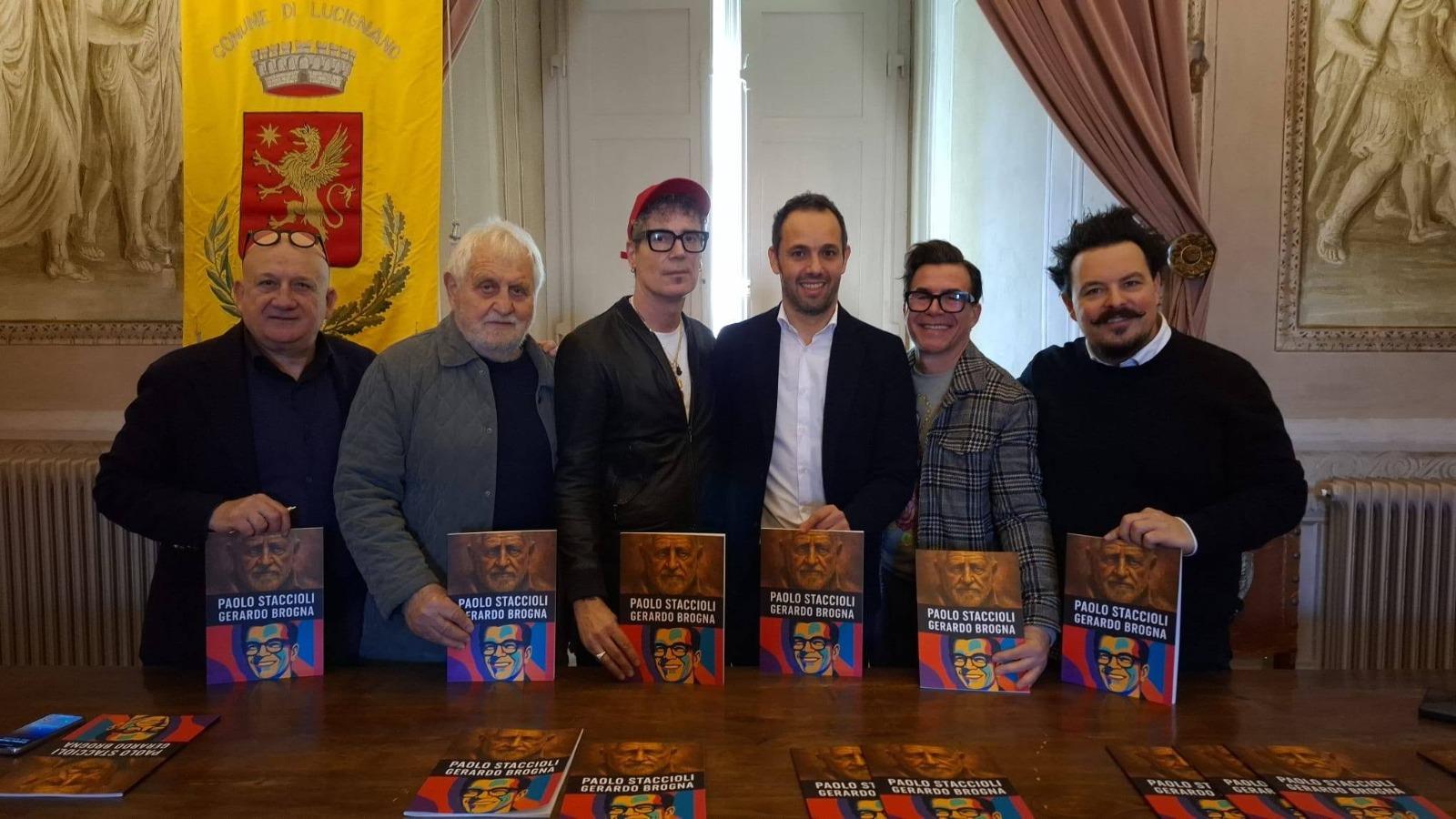


Some exhibitions begin as events, while others become, from the very first moment, places of dialogue. Materika belongs to this second category: it doesn’t simply present works, but connects languages, sensibilities, and visions, inviting the viewer to pause, to question, to feel. In Materika, the dialogue between Gerardo Brogna’s painting and Paolo Staccioli’s sculpture is built around matter, understood not as a simple support, but as a locus of meaning. Matter becomes a narrative, a memory, a living body that retains traces of the past while simultaneously opening up to the present. It is an exchange that seeks not overlaps, but subtle harmonies, fruitful differences, and never-predictable balances.
Roberta Casini
Mayor of Lucignano
Lucignano does not simply host contemporary art, but embraces it as a tool for interpreting its present, as a chance to reinterpret the heritage, history, and identity of the place through new, open, and uncompromising forms. In this sense, Materika marks a transition: from the use of space to its activation; from conservation to the production of meaning. The Rosini rooms thus become a place of transition, where the work is not presented as a finished object, but as an experience that demands time, attention, and a responsible gaze.
Stefano Cresti
Councilor for Tourism and Communication